
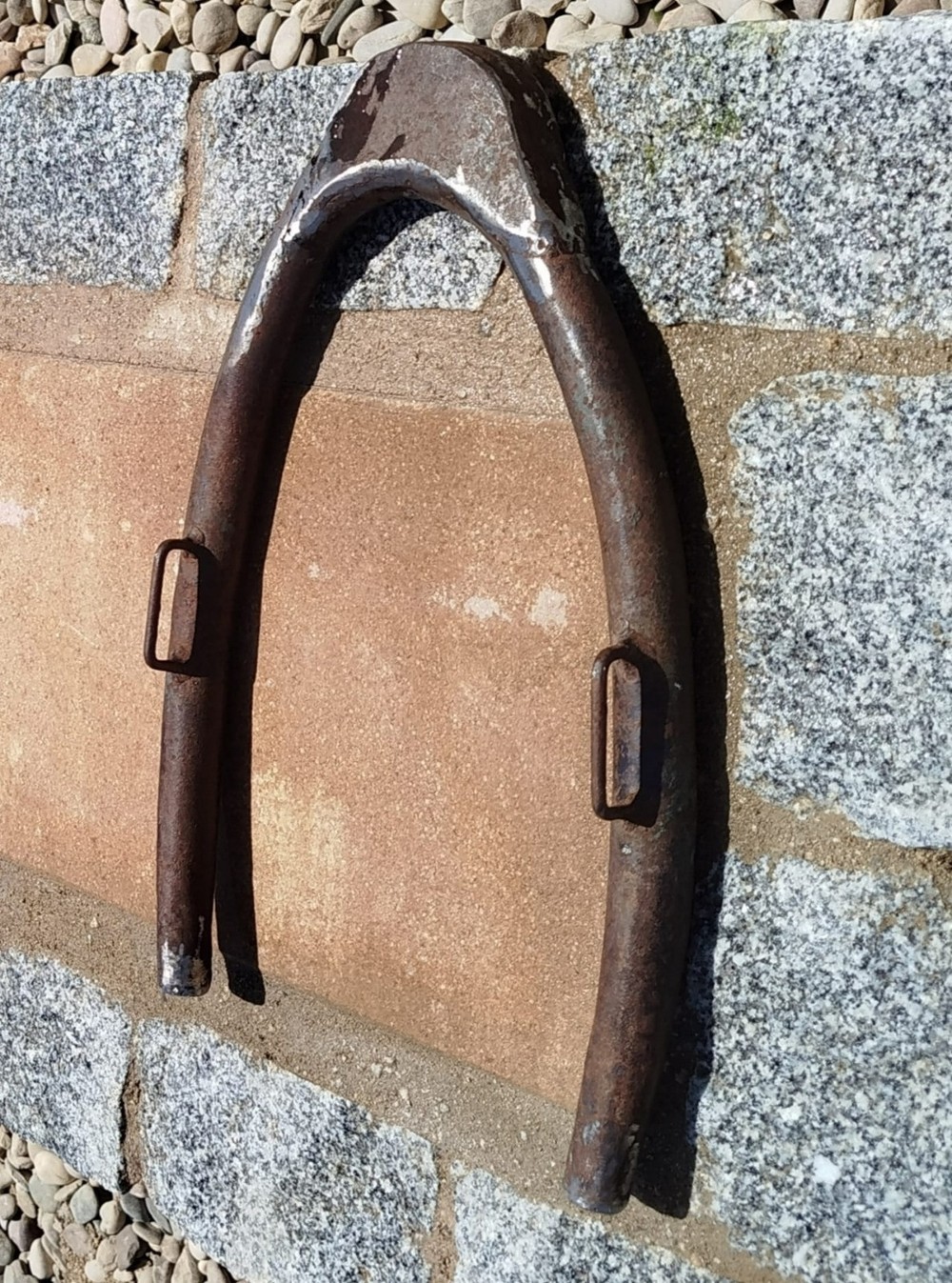
Utensilio de madera o de hierro, que se le ponía al burro, mulo, etc., delante del “anterrollo”
Las dos anillas que cuelgan se utilizaban para meter las correas de sujeción. Este arreo de labranza tiene forma de herradura y se usaba para una sola bestia. Si era para arar, esas correas se enganchaban a la “zanga” y si era para llevar un “volquete” se enganchaban a las “varas”. En el horcate va el tiro del arado o del volquete.
🇫🇷 Fourche
Ustensile en bois ou en fer que l’on mettait à l’âne, à la mule, etc., devant “l´avant-rouleau”. Les deux anneaux suspendus étaient utilisés pour insérer les curroies de serrage. Ce râteau de labourage avait la forme d’un fer a cheval et était utilisé pour une seule bête. Si c’était pour labourer, ils s’accrochaient à “la tranchée” et si c’était pour porter une benne, ils s’accrochaient aux cannes. Dans la fourche, il y a le tir de la charrue ou de la benne.
(Traducción por cortesía de Dña. Eulalia Cepas)
🇬🇧 Horcate (hame)
The ‘horcate’, or hame in English, was a wooden or iron implement which was fitted to a donkey, mule, or horse in front of the horse collar. The fastening straps were threaded through the two hanging rings. This farming harness is horseshoe-shaped and was used for a single animal. If it was for ploughing, the straps were attached to the plough beam, and if it was for pulling a cart, they were attached to the drawbars. The plough’s drawbar would be attached to the yoke.
(Traducción por cortesía de Mrs. Lucy McAuliffe (Academia Manhattan))
Copyright © ARIPE.
Aviso legal / Política de cookies

Design: Artificialis