
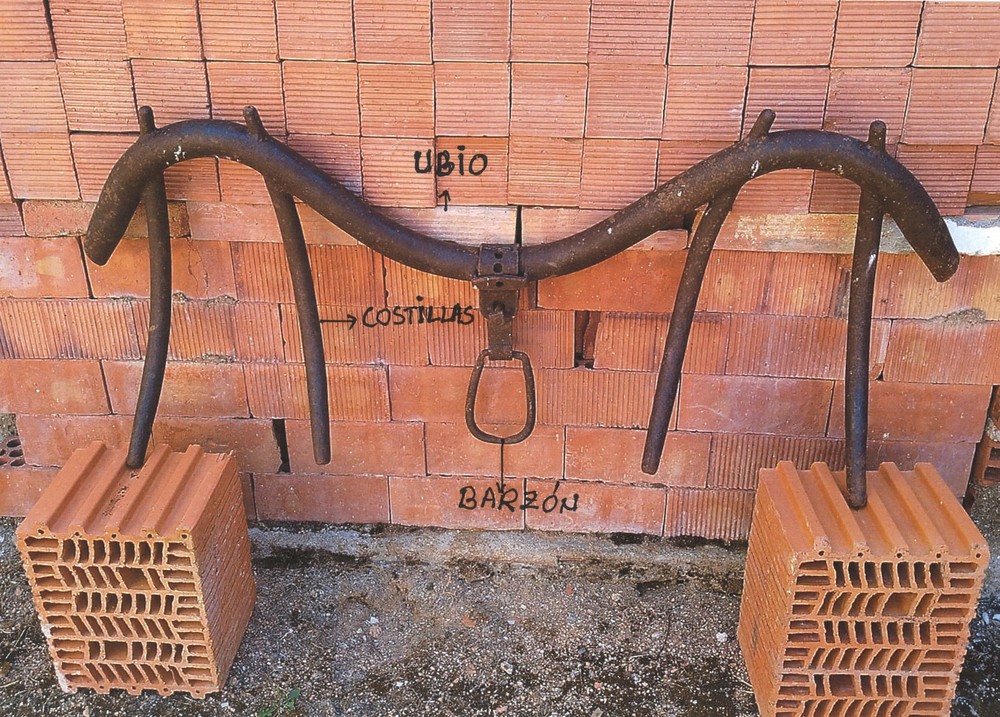
Apero que podía ser de hierro o de madera para una pareja de mulos que tiraban de un carro o que iban a tirar del arado, como en este caso.
La finalidad es que los dos mulos hicieran una fuerza similar y al mismo tiempo. Llevaban el “anterrollo” para proteger el cuello y unas “barrigueras” de cuero para ayudar a la sujeción. Hacía falta mucha fuerza y habilidad para subir el ubio y ponerlo en el cuello de las bestias para proceder a arar.
🇫🇷 Ubio:
Il s´agit d´un outil qui pouvait être en fer ou en bois pour un couple de mulets qui tiraient d´un chariot ou qui allaient tirer de la charrue, comme dans ce cas. Le but était que les deux mulets fassent une force similaire et simultanée. Ils portaient un «anterrollo» pour protéger le cou et des «protège-ventre» en cuir pour aider à la fixation. Il fallait beaucoup de force et d'habileté pour monter “l'ubio” et le mettre sur le cou des bêtes pour procéder au labourage.
(Traducción por cortesía de Dña. Eulalia Cepas)
🇬🇧 Yoke:
The yoke is a piece of equipment which could be made of iron or wood and was used for a pair of mules pulling a cart. The purpose was to ensure that both mules exerted a similar amount of force at the same time. They wore horse collars to protect their necks and leather girths to help secure the yoke. It took a great deal of strength and skill to lift the yoke and place it on the animals’ necks so that ploughing could begin. Fitting it onto the team pulling the cart was easier, as the animals would put their heads through it themselves.
(Traducción por cortesía de Mrs. Lucy McAuliffe (Academia Manhattan))
Copyright © ARIPE.
Aviso legal / Política de cookies

Design: Artificialis