
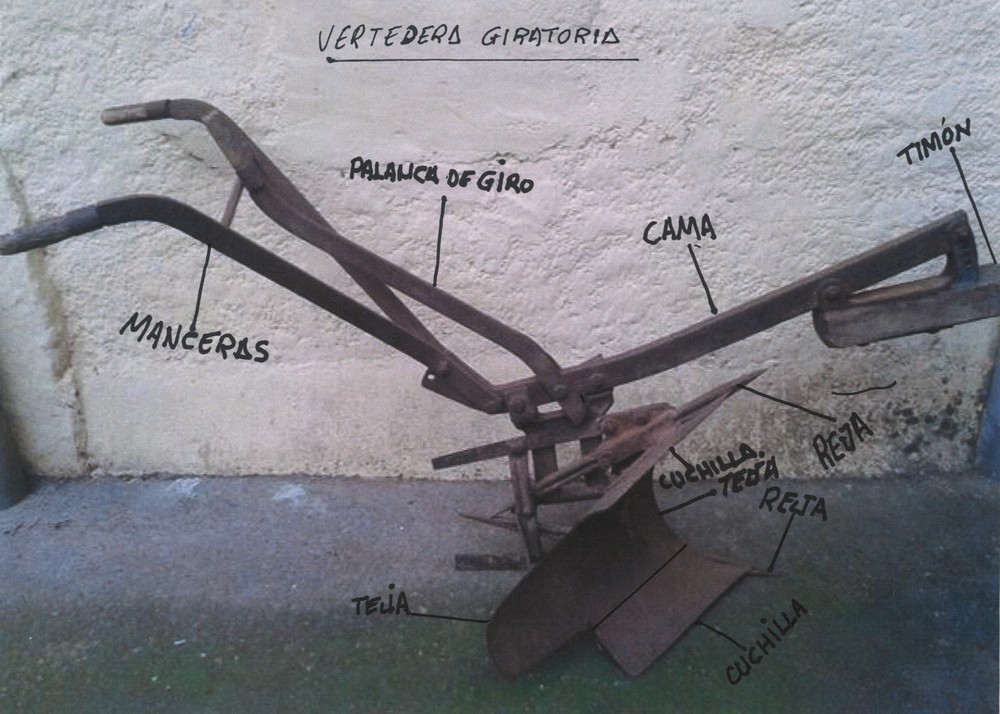
Es una herramienta agrícola de tracción animal, un tipo de arado tirado por un animal o una yunta para abrir el surco en la tierra.
Al primer arado, sobre la hierba, se le llamaba “barbechar” y quitar ortigas. Para sembrar no era conveniente puesto que hacía un surco muy hondo y la simiente no era capaz de nacer, por lo cual se perdía mucha. La vertedera giratoria se compone de la “cama”, la “teja”, dos “rejas”, dos “cuchillas” y las “manceras”. Éstas están unidas por una barrita de hierro. La teja tiene en cada lado una cuchilla y una reja. Desde la barrita que une las manceras va una palanca que se une a la cama por medio de un pasador para que pueda girar. Terminada en una “U” invertida vuelve a encajar en la teja y así nos permite arar sobre el mismo surco que hemos traído. Es muy útil para espacios de terreno pequeños como por ejemplo el huerto.
🇫🇷 Charrue tournante
C'est un outil agricole à traction animale, un type de charrue tirée par un animal ou une paire pour ouvrir le sillon dans la terre.
La première charrue sur l'herbe était appelée “barbechar” et enlever les orties. Pour semer,elle n'était pas pratique, car elle faisait un sillon très profond et les graines ne seront pas en mesure de germer, donc beaucoup ont été perdus. La charrue tournante est composée du “lit”, de la “tuile”, de deux “grilles”, de deux “lames” et des “manches”. Celles-ci sont reliées par une barre de fer. La “tuile” a de chaque côté une lame et une grille. De la barre qui relie les manches part un levier qui est attaché au lit par une goupille afin qu'il puisse tourner. Terminée en U inversé, elle s'adapte à nouveau sur la tuile et nous permet ainsi de labourer sur la même rainure que nous avons apportée. Il est très utile pour les petits espaces de terrain comme par exemple le jardin potager.
(Traducción por cortesía de Dña. Eulalia Cepas)
🇬🇧 Rotary plough
The rotary plough is an animal-drawn agricultural tool, a type of plough pulled by one animal or a team and used to cut a furrow in the soil. The first ploughing, carried out over grass, was known as ‘barbechar’ and involved removing nettles. The rotary plough was not suitable for sowing as it left a very deep furrow and the seed was thus unable to germinate, meaning much of it was wasted. The plough is made up of the plough beam, the mouldboard, two ploughshares, two coulters and the handles, which are joined by a small iron bar. The mouldboard has a ploughshare and a coulter on each side. A lever extends from the rod which connects the handles and is attached to the plough beam by a pin that allows it to rotate. Ending in an inverted ‘U’, it slots back into the mouldboard, thus allowing us to plough along the same furrow we have just made. It is very useful for small plots of land, such as a vegetable garden.
(Traducción por cortesía de Mrs. Lucy McAuliffe (Academia Manhattan))
Copyright © ARIPE.
Aviso legal / Política de cookies

Design: Artificialis